SMA syndrome diet and weight gain: how nutrition treatment works
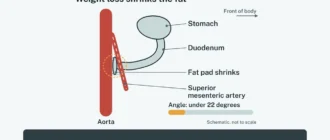
In superior mesenteric artery (SMA) syndrome, the duodenum (the first part of the small intestine) is pinched between two large arteries. The space between them is normally padded by a layer of fat. When that fat pad shrinks, usually after weight loss, the angle between the arteries narrows and food can no longer pass easily [1][12]. This is why an SMA syndrome diet plan, with careful weight gain, is usually the first treatment rather than surgery [1][2].
This page explains what nutrition treatment includes in published studies, how long it is usually tried, how doctors judge whether it is working, and when surgery is considered. It is general information, not a meal plan. Your care team and a dietitian are the right people to build a plan for you.
Key points
- The main goal of nutrition treatment is to rebuild the fat pad between the aorta and the SMA, which can reopen the space for the duodenum [1].
- Reviews describe body position changes, emptying the stomach with a tube, and nutrition support, with reported success rates of 70% to 80% [2].
- When eating by mouth is not enough, a feeding tube placed past the blockage or nutrition through a vein may be used [1][4].
- In a review of 189 malnourished patients, even modest weight gain was linked with success without surgery [3].
- Surgery, most often a bypass called duodenojejunostomy, is considered when nutrition treatment fails [1][2].
Why nutrition comes first
SMA syndrome is thought to follow the loss of fat around the mesentery, the tissue that holds the intestines in place. A recent review describes a narrowed angle (under 22 degrees) and a short distance (under 10 mm) between the aorta and the SMA [1]. Restoring that fat through nutrition is meant to widen the space again, so the treatment aims at the cause and not only at the symptoms [1].
A study of women with anorexia nervosa gives a picture of this. Of 51 patients who had CT scans for digestive complaints, 48 met imaging criteria for SMA syndrome. In 10 patients who were scanned again after nutritional recovery, the space between the arteries grew and digestive symptoms decreased [12].
What conservative care includes in studies
"Conservative care" means treatment without an operation. In published reviews and series it is built from several parts, chosen for each person:
- Resting the stomach. When vomiting is severe, a tube through the nose may be used to empty the stomach (decompression), along with fluids through a vein [2][10].
- Changing position after meals. Lying on the left side is often described as helpful, but the best position differs from person to person. In two older patients, ultrasound showed that sitting or bending forward opened the space more than lying flat [5].
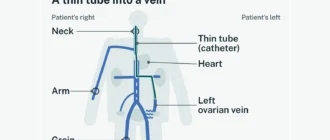
- Feeding past the blockage. A thin tube can be passed through the nose beyond the pinched part of the duodenum into the jejunum (the next part of the small intestine). This is called nasojejunal feeding. A surgically placed feeding tube (jejunostomy) is another option [1][11].
- Nutrition through a vein. Parenteral nutrition, sometimes called TPN, may be used alone or together with tube feeding until the blockage eases [4][11].
- Food by mouth, step by step. Single case reports describe going slowly from clear liquids to soft food and then solid food, or using small, frequent, low-fat meals [13][14]. This is case-level evidence only, and we found no study that compares specific foods or diets.
- Treating the cause of weight loss. In a systematic review, psychological care improved results, especially for people with eating disorders or other mental health conditions [3].
How long nutrition treatment is tried
There is no single agreed time limit, and the studies differ a lot:
- In a review of SMA syndrome after bowel (colorectal) surgery, about 63% of patients were treated successfully without an operation, most within 2 to 4 weeks. The authors suggest considering surgery if there is no improvement within 4 weeks [6].
- In a 20-year series of 22 children, treatment lasted an average of 65 days, and only one child needed surgery [7].
- In 21 children treated without surgery, 11 had their symptoms cut by more than half after 3 months, and their weight for age rose significantly after 6 months [8].
How success is judged
Doctors usually look at two things together: weight and symptoms. In a systematic review of 73 articles with 189 malnourished patients, a mean weight gain of about 5.6 kg (about 12% of body weight) was linked with successful treatment without surgery. The authors note that most of these reports had a higher risk of bias, so the exact target is uncertain [3]. In a small study of 16 children treated without surgery, results were good regardless of how long symptoms had lasted, body mass index, or the measured angle [17].
A symptom diary can help you and your team see changes over time. See our meal and symptom diary.
What our study summary shows
We collected results from every published study we could find on SMA syndrome treatment. In our summary of every published study:
| Measure | Result | Based on |
|---|---|---|
| Improved with conservative care alone | 86% (weighted) | 4 studies, 59 patients |
| Did not need surgery, when conservative care was tried first | median about 64% | 4 studies |
| Weight gain during conservative care | median about 3 kg | only 2 studies |
These numbers come from small studies and should be read with care. Many patients in surgical series had already tried nutrition treatment before their operation, so the groups are not directly comparable.
When surgery is considered
Surgery is recommended when conservative care fails. The most common operation is a duodenojejunostomy, which connects the duodenum to the jejunum to go around the pinched area, often by keyhole (laparoscopic) surgery. Reported success rates are 80% to 100% [2]. Some people still have nausea after surgery because the stomach may move food slowly after a long blockage [1]. Learn more on our page about duodenojejunostomy for SMA syndrome.
Special situations
After scoliosis surgery. SMA syndrome is a known complication of spine straightening surgery. In a review of 52 cases, patients whose symptoms began less than 48 hours after the spine operation were more likely to end up having surgery for SMA syndrome than conservative treatment [9].
Eating disorders. In people with anorexia nervosa, weight restoration together with psychological care is the main approach in the studies [3]. In one reported case, a bypass operation did not lead to weight gain, while later nutrition treatment with psychological support did [15].
Burns and critical illness. In a 12-year series, 37 of 3,536 burn patients developed SMA syndrome. After stomach decompression and nutrition through a vein became routine, the share needing an operation fell from 42% to 11% [10]. In burn patients, feeding through a tube past the blockage is described as the main method, with vein nutrition added when needed [11].
After weight-loss surgery. In a review of 20 cases after bariatric surgery, conservative care worked in only 15%, and most patients needed an operation [16].
Questions to ask your doctor
- What weight or symptom change would show that nutrition treatment is working for me?
- Do I need a feeding tube or nutrition through a vein, and for how long?
- Which body position after meals seems to help in my case?
- Can I work with a dietitian, and with a mental health specialist if needed?
- How long will we try this before talking about surgery?
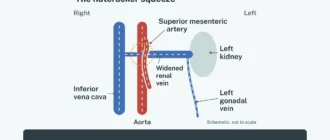
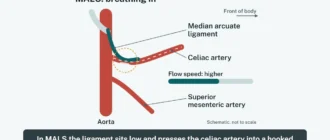
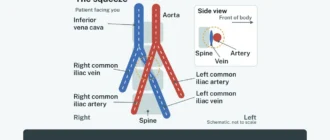
- Could another condition, such as MALS or nutcracker syndrome, be adding to my symptoms?
Related pages: SMA syndrome guide, SMA syndrome treatment results, duodenojejunostomy, meal and symptom diary.
Sources
- Maria MS, Anoosh F, Houssam O, et al. Superior mesenteric artery syndrome: a contemporary review of diagnosis and surgical management. J Gastrointest Surg. 2026;30(9):102506. PubMed 42501657
- Oka A, Awoniyi M, Hasegawa N, et al. Superior mesenteric artery syndrome: Diagnosis and management. World J Clin Cases. 2023;11(15):3369-3384. PubMed 37383896
- Gibson D, Plotkin M, Foster M, et al. Predictors of Successful Weight Restoration in the Treatment of Superior Mesenteric Artery Syndrome: A Systematic Review. Nutrients. 2025;17(18). PubMed 41010523
- Warncke ES, Gursahaney DL, Mascolo M, et al. Superior mesenteric artery syndrome: a radiographic review. Abdom Radiol (NY). 2019;44(9):3188-3194. PubMed 31127323
- Hasegawa N, Oka A, Awoniyi M, et al. Dynamic ultrasonography for optimizing treatment position in superior mesenteric artery syndrome: Two case reports and review of literature. World J Gastroenterol. 2024;30(5):499-508. PubMed 38414592
- Alsaleh N, Yaseen W, Alshamat RA, et al. Superior mesenteric artery syndrome following colorectal surgery: a systematic review. Ann Med Surg (Lond). 2025;87(5):2763-2773. PubMed 40337396
- Biank V, Werlin S. Superior mesenteric artery syndrome in children: a 20-year experience. J Pediatr Gastroenterol Nutr. 2006;42(5):522-5. PubMed 16707974
- Shiu JR, Chao HC, Luo CC, et al. Clinical and nutritional outcomes in children with idiopathic superior mesenteric artery syndrome. J Pediatr Gastroenterol Nutr. 2010;51(2):177-82. PubMed 20601910
- Fan Y, Cai M, Wang J, et al. Superior Mesenteric Artery Syndrome Following Scoliosis Surgery: A Systematic Review of Case Reports. Ann Vasc Surg. 2021;76:514-535. PubMed 33905850
- Lescher TJ, Sirinek KR, Pruitt BA Jr. Superior mesenteric artery syndrome in thermally injured patients. J Trauma. 1979;19(8):567-71. PubMed 469969
- Milner EA, Cioffi WG, McManus WF, et al. Superior mesenteric artery syndrome in a burn patient. Nutr Clin Pract. 1993;8(6):264-6. PubMed 8302259
- Taieb L, Meziane Y, Renard Y, et al. Aorto-mesenteric space reduction in women with anorexia nervosa: retrospective audit and analysis. J Eat Disord. 2026;14(1). PubMed 41787559
- Tharu S, Tharu B, Mahgoub M, et al. Superior Mesenteric Artery Syndrome: A Classic Presentation of a Rare Entity. Cureus. 2020;12(8):e9990. PubMed 32983690
- Abdi MH, Yallew GM, Moumin HE, et al. Effective conservative management of superior mesenteric artery syndrome presenting with chronic vomiting and postprandial pain in a young adult female: a case report. Int J Surg Case Rep. 2026;138(5):1683-1687. PubMed 42130604
- Kurisu K, Yamanaka Y, Yamazaki T, et al. A clinical course of a patient with anorexia nervosa receiving surgery for superior mesenteric artery syndrome. J Eat Disord. 2021;9(1):79. PubMed 34193279
- Mitchell S, Kelly M, Lucocq J, et al. Superior Mesenteric Artery Syndrome Following Bariatric Surgery: A Systematic Review. Obes Surg. 2026;36(4):1955-1964. PubMed 41795062
- Martinez Diaz M, Couselo Jerez M, Valdes Dieguez E, et al. Conservative treatment of superior mesenteric artery syndrome. Cir Pediatr. 2025;38(4):130-136. PubMed 41201851
MALS Compass is an independent educational website, not a medical provider, and is not affiliated with any hospital, clinic or university. This page is educational information and does not replace advice from your own doctor. For any question about your health, please contact your doctor or an official healthcare institution.