May-Thurner syndrome: compression of the left iliac vein
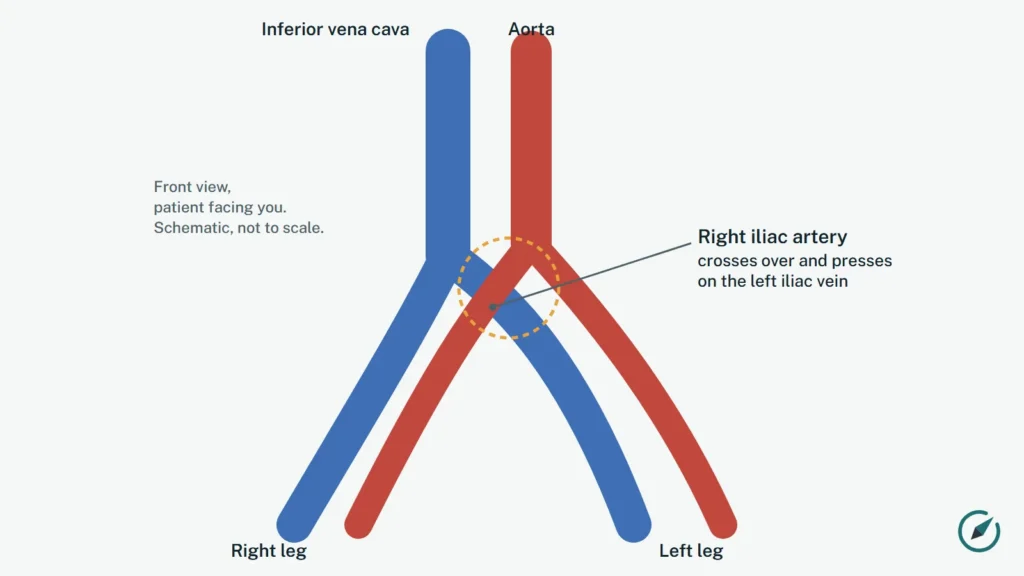
May-Thurner syndrome is a condition in which the left common iliac vein, a large vein that carries blood from the left leg, is pressed between the lower spine and the right common iliac artery. Most people with this anatomy have no symptoms, but in some it leads to leg swelling, pain or a blood clot in the deep veins of the leg (deep vein thrombosis, DVT) [1][2].
Key points
- It is also called iliac vein compression syndrome or Cockett syndrome [2].
- Narrowing of the iliac vein is common in people without symptoms; it becomes a syndrome when it causes leg symptoms or a clot [1][2].
- The left leg is affected far more often than the right, and women more often than men [2].
- Intravascular ultrasound (IVUS) finds the narrowing much more reliably than a standard venogram [2].
- A stent in the vein is a common treatment; a large review of 27 studies found good results and few serious complications [3].
What happens in the body
Where the right common iliac artery crosses over the left common iliac vein, the vein can be pinched against the spine. Doctors also describe webs or "spurs" inside the vein at this point [2]. Compression of a vein can raise the pressure in the veins below it or lead to a clot [6]. Variants that affect the right leg are also known [1].
How May-Thurner syndrome squeezes the iliac vein (4 steps)

1. Normal anatomy. The two common iliac veins join to form the inferior vena cava. On the way, the left common iliac vein usually passes behind the right common iliac artery, in front of the lower spine. Source: study 1, study 2.

2. The squeeze. In May-Thurner syndrome, the right common iliac artery presses the left common iliac vein against the lower spine. A squeeze alone is common: in one CT study of 50 people without leg vein symptoms, 24% had more than 50% compression. Source: study 1, study 2.

3. Slow flow, clot risk. Blood from the left leg drains less easily and can pool. This raises the risk of a clot in a deep vein of the left leg (deep vein thrombosis, DVT). Left leg swelling and pain are common symptoms. In one series of 523 patients, 65% had DVT and 54% leg swelling. Source: study 1, study 2, study 3, study 4.

4. A stent holds it open. A stent, a mesh tube placed inside the narrowed vein, holds it open against the artery. In one study of 155 patients without clots, 96% to 99% of stents stayed open over a median of 42 months. In selected patients, pain and swelling improved. Source: study 1, study 2, study 3.
Prefer a video? Watch the 90-second captioned video explainer.
Who gets it
Non-thrombotic narrowing of the iliac vein is found often in the general population, including in many people without symptoms [2]. In a large group of patients with chronic vein disease who were examined with IVUS, women outnumbered men about 4 to 1 and the left side was affected about 3 times as often as the right; the median age was 54 years [2]. The condition also occurs in children and teenagers: a review of 109 young patients with May-Thurner syndrome and a clot found that most also had at least one other risk factor for clots [4].
Symptoms
Many people never have symptoms. When it does cause problems, the most common is a deep vein thrombosis in the left leg [1]. Other symptoms are those of chronic vein disease [2]:
- swelling of the leg, often the left leg;
- leg pain;
- slow-healing wounds (venous ulcers).
After a clot, long-lasting pain and swelling (post-thrombotic syndrome) are common: in the review of young patients it occurred in 61% [4].
How it is diagnosed
Imaging of the veins is needed, and doctors use several methods [1]. The most sensitive test is intravascular ultrasound, a tiny ultrasound probe placed inside the vein. In one large study, IVUS detected the narrowing with a sensitivity of more than 90%, while a standard venogram was only 66% sensitive and looked normal in about a third of affected limbs [2].
Treatment
- Blood thinners (anticoagulants) are the standard treatment for a deep vein thrombosis [7].
- Clot removal: when there is a clot in the large veins of the pelvis and thigh, doctors may dissolve or remove it with a catheter-based treatment [8].
- Stenting: a metal mesh tube placed inside the vein keeps it open. A review of 27 studies with 4,782 patients found consistently high rates of the stent staying open, especially when there was no clot, with improved pain, swelling and quality of life and uncommon serious complications [3]. In one large series, complete pain relief 2.5 years after stenting was reported in 77% to 82% of limbs, depending on the group [2].
How well does stenting work? See stent success rates from every published study: how often the stent stays open, symptom relief, ulcer healing and repeat procedures, side by side.
Where is it treated? See US hospitals that publish on May-Thurner syndrome, by state.
Pregnancy and May-Thurner syndrome
Pregnancy increases the tendency of blood to clot. A systematic review of 76 women with 87 pregnancies after an iliac vein stent found that the stents performed well; stent blockage occurred in one woman. The authors recommended blood thinners for women with stents during pregnancy until more data are available [5]. Talk to your vascular specialist and obstetrician before and during pregnancy.
Other compression syndromes
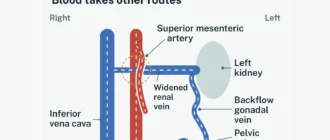
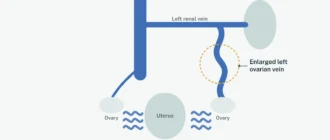
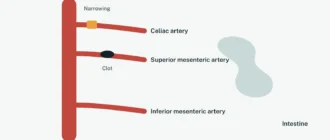
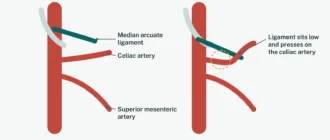
May-Thurner syndrome is one of several conditions in which a vein or artery is compressed by nearby structures. Others include nutcracker syndrome (left kidney vein) [6], SMA syndrome (duodenum) and MALS (celiac artery). See also pelvic congestion syndrome.
ICD-10 code
The US ICD-10-CM 2026 code set has no specific entry for May-Thurner syndrome. A general code for compression of a vein, I87.1, exists; a clot is coded separately.
Questions to ask your doctor
- Was the narrowing confirmed with intravascular ultrasound or only on a scan?
- Are my symptoms caused by the narrowing, or could there be another reason?
- Do I need a stent, and how long will I need blood thinners afterwards?
- What should I do if I plan a pregnancy or long travel?
Current clinical studies
19 registered studies, 3 open or opening soon.
Source: ClinicalTrials.gov (U.S. National Library of Medicine), checked November 9, 2026. Status is shown as reported by the registry. A listing is not an endorsement and does not mean a study is right for you: read the official record and discuss it with your doctor.
See all conditions on our clinical trials tracker.
Sources
- Poyyamoli S, Mehta P, Cherian M, et al. May-Thurner syndrome. Cardiovasc Diagn Ther. 2021;11(5):1104-1111. PubMed 34815961
- Raju S, Neglen P. High prevalence of nonthrombotic iliac vein lesions in chronic venous disease: a permissive role in pathogenicity. J Vasc Surg. 2006;44(1):136-43; discussion 144. PubMed 16828437
- Li M, Wang S, Zhao J, et al. Iliac vein stenting outcomes in non-thrombotic and thrombotic diseases: A systematic review and meta-analysis. Biomol Biomed. 2025;26(5):759-773. PubMed 41090385
- Avila L, Cullinan N, White M, et al. Pediatric May-Thurner Syndrome-Systematic review and individual patient data meta-analysis. J Thromb Haemost. 2021;19(5):1283-1293. PubMed 33651481
- Villalba L, Vaddavalli VV, Tripathi RK. Iliac vein stenting and pregnancy. J Vasc Surg Venous Lymphat Disord. 2023;11(6):1276-1284. PubMed 37572777
- White JM, Comerota AJ. Venous Compression Syndromes. Vasc Endovascular Surg. 2017;51(3):155-168. PubMed 28330436
- Ortel TL, Neumann I, Ageno W, et al. American Society of Hematology 2020 guidelines for management of venous thromboembolism: treatment of deep vein thrombosis and pulmonary embolism. Blood Adv. 2020;4(19):4693-4738. PubMed 33007077
- Sudheendra D, Vedantham S. Catheter-Directed Therapy Options for Iliofemoral Venous Thrombosis. Surg Clin North Am. 2018;98(2):255-265. PubMed 29502770
MALS Compass is an independent educational website, not a medical provider, and is not affiliated with any hospital, clinic or university. This page is educational information and does not replace advice from your own doctor. For any question about your health, please contact your doctor or an official healthcare institution.