Pelvic congestion syndrome: chronic pelvic pain from the veins
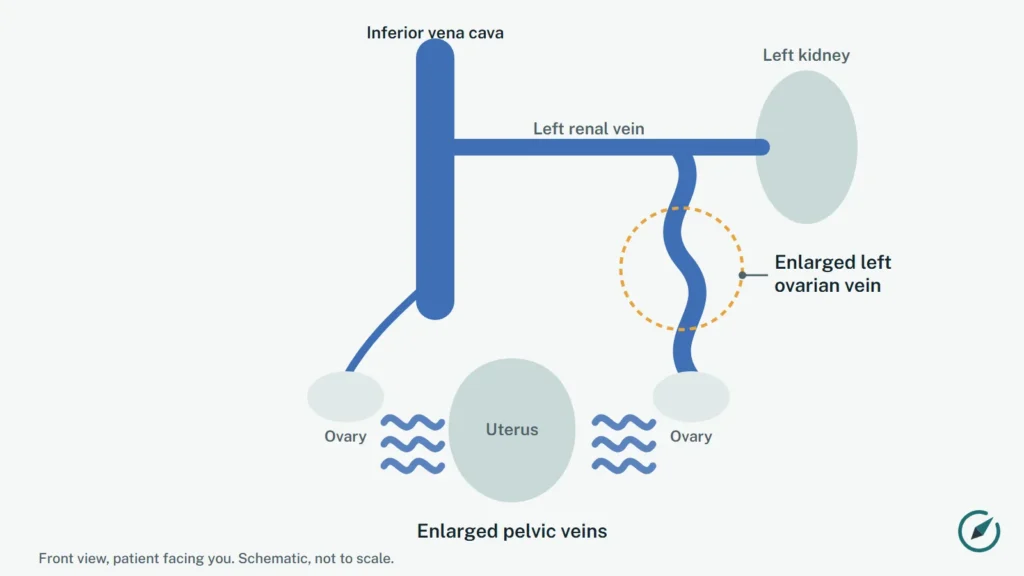
Pelvic congestion syndrome is a cause of long-lasting pelvic pain in women that is linked to widened, backward-flowing veins in the pelvis. It is still poorly understood, its symptoms overlap with many other conditions, and it is often diagnosed only after other causes of pelvic pain have been ruled out [1].
Key points
- Doctors increasingly use the broader term pelvic venous disorders (PeVD) for this group of conditions [2].
- Typical pain lasts more than six months, is worse before periods and after standing or walking, and can come with pain during or after sex [3].
- Assessment includes ruling out other causes and imaging of the pelvic veins, the ovarian veins and the iliac veins [2].
- Blocking the faulty veins from the inside (embolization) relieves pain in most women in published studies, but the quality of the evidence is still low [4][5].
- It can be connected with compression syndromes such as nutcracker syndrome and iliac vein compression (May-Thurner syndrome) [2][6].
What happens in the body
Veins in the pelvis carry blood from the uterus, ovaries and other organs back toward the heart. Doctors look for blood flowing the wrong way in the ovarian veins, widened pelvic veins (pelvic varicose veins) and narrowing of the iliac veins, the main outflow from the pelvis [2]. The condition usually, but not only, occurs in women who have had more than one pregnancy [3].
Two compression syndromes can push blood into the pelvic veins:
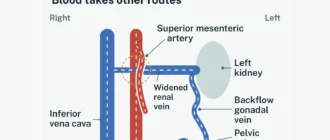
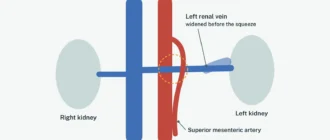
- In nutcracker syndrome the left kidney vein is compressed, and blood can be diverted toward the pelvis through the left ovarian vein [6][7].
- In iliac vein compression (May-Thurner syndrome) the outflow from the pelvis and leg is narrowed; signs of iliac vein compression are part of the imaging assessment for pelvic venous pain [2].
How pelvic congestion syndrome develops (4 steps)

1. Normal ovarian veins. Each ovary has a vein that carries blood back toward the heart. The left ovarian vein drains into the left renal (kidney) vein, the right one into the inferior vena cava. In most women, small valves inside keep blood moving up. Source: study 1.

2. Faulty valves, backward flow. In pelvic congestion syndrome, valves in an ovarian vein do not work well, so blood flows backward, down toward the pelvis (reflux). It is most often the left ovarian vein: 78% of women in one large study. Source: study 1, study 2, study 3.


Prefer a video? Watch the 90-second captioned video explainer.
Symptoms
Reported symptoms include [3]:
- chronic pelvic pain of varying intensity, lasting more than six months;
- pain that is worse before periods and after walking, standing or tiredness;
- painful periods and pain during or after sex;
- bladder irritation and discomfort in the rectum.
Because the symptoms are non-specific, women are often seen by many specialists, including gynecologists, vascular specialists, pain specialists and gastroenterologists, before the diagnosis is made. Long delays can contribute to anxiety and depression [3].
How it is diagnosed
The work-up looks for other causes of pelvic pain first. Imaging then looks for pelvic varicose veins wider than 5 mm, the width and flow direction of the ovarian veins, and the width of the iliac veins and signs of compression [2]. Non-invasive imaging such as ultrasound helps exclude other causes, and a venogram (an X-ray of the veins with contrast) is described as the definitive test, usually done right before treatment [3].
Treatment
- Embolization: the faulty ovarian or pelvic veins are closed from the inside with coils, plugs, glue or a sclerosing liquid, through a thin catheter. A systematic review of 1,308 women found early substantial pain relief in about 75%, generally sustained over time, with a risk of coil migration below 2%; the authors rated the evidence as low quality [4]. A 2026 meta-analysis of 2,688 patients found technical success of 98.6% to 100% across methods and a clear reduction in pain scores, with device migration most often seen with coils [5].
- Iliac vein stenting: when iliac vein compression is part of the problem, a stent may be used, alone or with embolization [2].
- Other options: conservative, medical and surgical treatments have been reported, but in specialist practice they have largely been replaced by embolization [3].
Experts note that large randomized trials are still missing, and that the link between widened pelvic veins and pain has not been proven in every case [1][4].
ICD-10 code
In the US ICD-10-CM 2026 code set, the index entry "pelvic congestion-fibrosis, female" points to code N94.89, and pelvic varices have their own code, I86.2.
Pregnancy and pelvic congestion
Pregnancy is a known risk factor for vein problems, and pelvic congestion is found mostly in women before menopause, often after a pregnancy [8][9]. In one study of 297 women with vein disease, those with three or more pregnancies had more advanced disease, and nearly 40% of them had a recurrence. Women who had never been pregnant could also have vein disease, and most of them responded very well to treatment [8]. Pain from pelvic varicose veins is described as worse with long standing, sex, periods and pregnancy [10].
Data on pregnancy after treatment are limited. A systematic review found few data on periods, egg supply in the ovaries (ovarian reserve) or fertility after embolization, but no concerns were noted [4]. In a small study of 12 women whose infertility was thought to be caused by pelvic congestion, 8 became pregnant after ovarian vein embolization [12]. In another small study of 8 women who had a baby after coil embolization, no coils moved, but backward flow came back in at least one main pelvic vein in 5 of them; after recovery from pregnancy, a repeat embolization can close these veins again [11]. In 15 women who became pregnant after an iliac vein stent, no stent clotted and none needed a repeat procedure because of the pregnancy [13].
These studies are small, and none of them sets a best time for treatment in relation to a planned pregnancy, so family plans are worth discussing with the treating team.
Questions to ask your doctor
- Which other causes of my pelvic pain have been ruled out?
- Did the imaging look at the ovarian veins, the iliac veins and the left kidney vein?
- Could nutcracker syndrome or iliac vein compression be involved?
- What results and risks should I expect from embolization, and how many of these procedures does your team perform?
How well does treatment work? See embolization success rates from every published study: improvement rates, pain scores before and after, recurrence and complications, side by side.
Read more: how pelvic congestion is diagnosed (ultrasound and other tests), ovarian vein embolization (what happens, recovery, results) and pelvic vein problems in men.
In the UK? See pelvic congestion syndrome on the NHS: GP, referral, the procedure and official guidance.
Where is it treated? See US hospitals that publish on pelvic congestion syndrome, by state.
Current clinical studies
29 registered studies, 8 open or opening soon.
Source: ClinicalTrials.gov (U.S. National Library of Medicine), checked November 9, 2026. Status is shown as reported by the registry. A listing is not an endorsement and does not mean a study is right for you: read the official record and discuss it with your doctor.
See all conditions on our clinical trials tracker.
Sources
- Alsannan B, Alzeeny A, Etrusco A, et al. Diagnosis and Management of Pelvic Congestion Syndrome: Comprehensive Review. Gynecol Obstet Invest. 2024;89(6):437-444. PubMed 38981444
- Ford RW, Winokur RS. Pelvic Venous Disorders (PeVD). Semin Intervent Radiol. 2022;39(5):483-489. PubMed 36561941
- Kashef E, Evans E, Patel N, et al. Pelvic venous congestion syndrome: female venous congestive syndromes and endovascular treatment options. CVIR Endovasc. 2023;6(1):25. PubMed 37076700
- Daniels JP, Champaneria R, Shah L, et al. Effectiveness of Embolization or Sclerotherapy of Pelvic Veins for Reducing Chronic Pelvic Pain: A Systematic Review. J Vasc Interv Radiol. 2016;27(10):1478-1486.e8. PubMed 27397619
- Strobl F, Bohm AK, Mertens L, et al. Pelvic vein embolization using different embolic agents for the treatment of pelvic venous insufficiency: A systematic review and meta-analysis. J Vasc Surg Venous Lymphat Disord. 2026;14(6):102599. PubMed 42571790
- Kolber MK, Cui Z, Chen CK, et al. Nutcracker syndrome: diagnosis and therapy. Cardiovasc Diagn Ther. 2021;11(5):1140-1149. PubMed 34815965
- Said SM, Gloviczki P, Kalra M, et al. Renal nutcracker syndrome: surgical options. Semin Vasc Surg. 2013;26(1):35-42. PubMed 23932560
- Wilczko J, Szary C, Bodziony A, et al. May the Number of Pregnancies Predict the Progression and the Outcome of Venous Disease Treatment? Diagnostics (Basel). 2023;13(15). PubMed 37568897
- Krambeck C, Tesch K, Watrowski R, et al. Pelvic Congestion Syndrome: The Gynecological Perspective. J Clin Med. 2026;15(4). PubMed 41753340
- Phillips D, Deipolyi AR, Hesketh RL, et al. Pelvic congestion syndrome: etiology of pain, diagnosis, and clinical management. J Vasc Interv Radiol. 2014;25(5):725-33. PubMed 24745902
- Dos Santos SJ, Holdstock JM, Harrison CC, et al. The effect of a subsequent pregnancy after transjugular coil embolisation for pelvic vein reflux. Phlebology. 2017;32(1):27-33. PubMed 26769721
- Liu J, Han L, Han X. The Effect of a Subsequent Pregnancy After Ovarian Vein Embolization in Patients with Infertility Caused by Pelvic Congestion Syndrome. Acad Radiol. 2019;26(10):1373-1377. PubMed 30660471
- Pappas PJ, Lakhanpal G, Soto T, et al. Pregnancy after iliac vein stenting for pelvic venous insufficiency. J Vasc Surg Venous Lymphat Disord. 2022;10(2):342-347. PubMed 34587526
MALS Compass is an independent educational website, not a medical provider, and is not affiliated with any hospital, clinic or university. This page is educational information and does not replace advice from your own doctor. For any question about your health, please contact your doctor or an official healthcare institution.