Pelvic congestion syndrome and ovarian vein embolization: video explainer
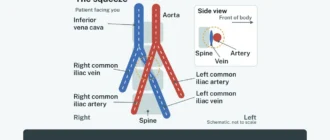
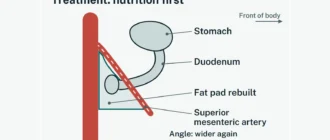
A short captioned video, about a minute and a half, with no sound. It shows how faulty valves let blood flow backward in the ovarian veins and widen the pelvic veins, and how ovarian vein embolization is done, step by step.
Chapters
- Normal ovarian veins
- Faulty valves, backward flow
- Pelvic veins widen
- Treatment: embolization
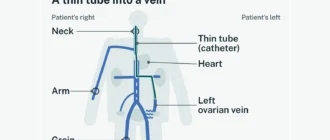
- Embolization: A thin tube into a vein
- Embolization: Dye X-ray finds faulty veins
- Embolization: Closing the faulty vein
- Embolization: After the procedure
Full transcript
- 0:03 Each ovary has a vein that carries blood back toward the heart.
- 0:08 In most women, small valves inside keep the blood moving up.
- 0:12 In pelvic congestion syndrome the valves do not work well, so blood flows backward.
- 0:18 Most often it is the left ovarian vein: 78% of women in one large study.
- 0:24 Over time the veins around the uterus and ovaries widen.
- 0:28 The ache is often worse after standing, during or after sex, and before periods.
- 0:34 Embolization closes the faulty vein from inside with coils, plugs, glue or a sclerosant.
- 0:39 In one long-term study, 83% of women felt better.
- 0:46 Often with only local numbing, a thin tube (catheter) goes into a vein in the groin, neck or arm.
- 0:53 It is steered into the faulty ovarian vein.
- 0:57 Dye and X-ray pictures (venography) show which veins let blood flow backward.
- 1:02 The faulty veins are closed from inside with coils, plugs, glue or foam.
- 1:07 In a review of 28 studies, technical success was 98.6% to 100%.
- 1:13 Many women go home the same day.
- 1:15 In one study, 1 in 5 had a pain flare that cleared with medicine by day 30.
About this video
- The drawings are schematic and not to scale. Each step is based on published research; the sources are listed with the same steps in our pelvic congestion syndrome guide.
- Numbers in the video come from single studies and are examples, not predictions for one person.
- This video is educational only and is not medical advice. Talk with your doctor about your own situation.
See also: embolization results from every published study and US hospitals that publish on it.
MALS Compass is an independent educational website, not a medical provider, and is not affiliated with any hospital, clinic or university. This page is educational information and does not replace advice from your own doctor. For any question about your health, please contact your doctor or an official healthcare institution.