Pelvic congestion syndrome in the UK: getting help on the NHS
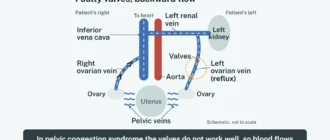
Pelvic congestion syndrome is long-lasting pelvic pain linked to widened, backward-flowing veins in the pelvis. This page is for readers in the UK: who to see first on the NHS, what the usual path to treatment looks like, what the procedure (pelvic vein embolisation, spelled embolization in the US) involves according to UK patient information, and what official guidance exists. We checked the official sources on 9 November 2026.
Key points
- The NHS advises seeing a GP for pelvic pain that comes and goes or does not go away, and using NHS 111 for urgent warning signs (official source 1).
- The NHS website has a general page on pelvic pain but, when we checked, no separate page on pelvic congestion syndrome (official sources 1 and 2).
- Pelvic vein embolisation is carried out by an interventional radiologist, usually under local anaesthetic, and most people go home the same day (official source 3).
- When we searched, NICE had no guidance specific to pelvic vein embolisation or pelvic congestion syndrome (official source 4).
- Across published studies, most women report less pain after embolisation; a UK-led review found early substantial relief in about 75% [1].
Step 1: see a GP
The NHS page on pelvic pain says to see a GP if pelvic pain comes and goes or does not go away, and also if you have bloating that does not go away, are losing weight without trying, feel full quickly, or have constipation or diarrhoea that does not go away. It lists urgent signs for NHS 111, such as finding it difficult to pee or poo, blood in your pee or poo, unusual bleeding from the vagina, a very high temperature, or being pregnant (official source 1).
The NHS also notes that getting diagnosed may take some time, because pelvic pain looks similar to many other conditions, and that it helps to share as much information with your doctor as possible (official source 1). Our symptom diary can help you note when the pain happens.
Step 2: ruling out other causes
Pelvic pain has many causes. The NHS page names, among others, period pain, ovarian cysts, endometriosis, irritable bowel syndrome and urinary infections (official source 1). Pelvic congestion syndrome is usually considered when these have been looked at and imaging shows widened pelvic veins. Our guide explains how pelvic congestion is diagnosed, including ultrasound and venography.
Step 3: referral to interventional radiology
The British Society of Interventional Radiology (BSIR) patient leaflet describes the usual pathway: before the procedure you may meet one of the interventional radiologists, the doctors who carry it out, and you may need blood tests and other tests. You sign a consent form and can change your mind at any time (official source 3).
What the procedure involves, according to UK patient information
- It takes up to 1 to 2 hours, lying on a flat table, usually with local anaesthetic; some people are given sedation (official source 3).
- A thin plastic tube is placed in a vein in the groin, the neck or both, guided by ultrasound. X-ray dye shows the faulty veins, which are then blocked with foam, liquid, coils or a mix; these stay in the vein permanently (official source 3).
- Usually no stitches are needed; the small plaster is kept dry for 2 to 3 days (official source 3).
- If your checks are normal you go home that afternoon or evening, not driving or using public transport, ideally with someone staying with you for 24 hours (official source 3).
- Exercise that involves straining, such as lifting weights or squats, is avoided for about six weeks so that coils do not move; the leaflet advises going to A&E if breathing problems develop (official source 3).
Our page on ovarian vein embolisation shows the procedure step by step, and there is a 90-second captioned video.
Risks and results
The BSIR leaflet describes the procedure as relatively safe with mostly minor complications, such as bruising or infection where the tube went in and discomfort afterwards. Rarer risks include an effect of the X-ray dye on the kidneys or an allergic reaction, and, rarely, material moving to the heart or lungs (non-target embolisation). It states that the main risk is that symptoms come back, in 10% to 40% of cases (official source 3).
A systematic review led by UK researchers included 21 case series and one trial with 1,308 women. Early substantial pain relief was seen in about 75% of women after embolisation, and repeat treatment rates were generally low; the evidence was of limited quality [1]. In our summary of every published study, 85% of 3,875 women improved, weighted by study size.
Official guidance
When we searched the NICE website on 9 November 2026, a search for "pelvic vein embolisation" returned no guidance, and a search for "pelvic congestion syndrome" returned only one older document on a different procedure for chronic pelvic pain (laparoscopic uterine nerve ablation, HTG150) (official source 4). Availability of pelvic vein embolisation can therefore differ between NHS trusts; ask your GP or specialist where it is offered locally.
UK hospitals that publish on pelvic congestion
Our list of hospitals that publish on pelvic congestion syndrome has a country filter: choose "UK" to see UK hospitals whose doctors have published on the condition. Publishing shows research interest, not quality of care.
Questions to ask on the NHS
- Which other causes of my pain have been ruled out, and which tests are still needed?
- Can I be referred to a gynaecologist or an interventional radiologist with experience of pelvic vein problems?
- Is pelvic vein embolisation offered by my local NHS trust, and what is the waiting time?
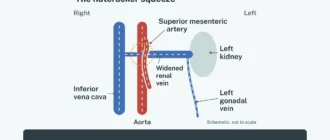
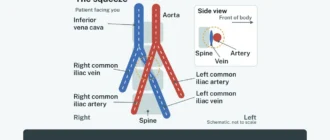
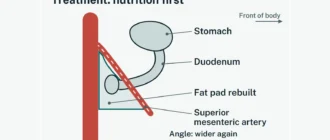
- Could a squeezed vein higher up (nutcracker syndrome or May-Thurner syndrome) be involved?
- What should I do if the pain comes back after treatment?
Read our full guide to pelvic congestion syndrome.
Official sources (checked 9 November 2026)
- NHS website: Pelvic pain. nhs.uk/symptoms/pelvic-pain
- NHS website search for "pelvic congestion syndrome": general pages only, no condition page.
- British Society of Interventional Radiology: Pelvic Congestion Syndrome and Pelvic Vein Embolisation, patient information sheet (2025). bsir.org (PDF)
- NICE website search for "pelvic vein embolisation" (no results) and "pelvic congestion syndrome" (one result: HTG150, laparoscopic uterine nerve ablation for chronic pelvic pain).
Sources
- Daniels JP, Champaneria R, Shah L, et al. Effectiveness of Embolization or Sclerotherapy of Pelvic Veins for Reducing Chronic Pelvic Pain: A Systematic Review. J Vasc Interv Radiol. 2016;27(10):1478-1486.e8. PubMed 27397619
MALS Compass is an independent educational website, not a medical provider, and is not affiliated with any hospital, clinic or university. This page is educational information and does not replace advice from your own doctor. For any question about your health, please contact your doctor or an official healthcare institution.