SMA syndrome treatment: results of surgery and nutrition from every published study
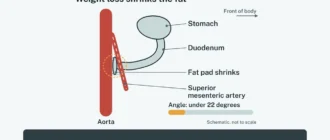
In superior mesenteric artery (SMA) syndrome, the duodenum is squeezed between the aorta and the superior mesenteric artery, usually after major weight loss. Treatment starts with nutrition to restore the fat pad between the two arteries; when that is not enough, surgeons bypass or release the trapped duodenum. SMA syndrome is rare, so each hospital sees few patients. We read the abstracts of every SMA syndrome treatment study in PubMed and put the numbers side by side.
What the numbers show
- Across published surgical series, about eight in ten patients have their symptoms resolved or improved, but the studies are small: most report fewer than 20 patients.
- Nutrition and conservative care help many patients; in the studies that tried it first, a median of about six in ten did not need surgery.
- Results differ widely between hospitals and operations, from one third to all patients improving, partly because studies define success differently.
- Some patients keep having symptoms after a technically successful operation, often because of other gut motility problems.
- There are no large trials comparing operations, so no single operation can be called the best from these data.
Results by treatment
"Improved (weighted)" counts every patient once, so large studies count more. "Median study" is the middle value when studies are lined up from lowest to highest success. With so few studies per row, a single hospital can move a number a lot.
| Treatment | Studies with a rate | Patients | Improved (weighted) | Median study | Range |
|---|---|---|---|---|---|
| Laparoscopic duodenojejunostomy (bypass) | 6 of 10 | 77 | 66% | 75% | 33%-92% |
| Duodenojejunostomy, approach not stated | 1 of 4 | 8 | 100% | 100% | 100%-100% |
| Strong procedure (duodenal release) | 2 of 2 | 11 | 91% | 88% | 75%-100% |
| Duodenal derotation or transposition | 3 of 3 | 58 | 93% | 93% | 91%-100% |
| Other or unnamed operation | 2 of 2 | 59 | 97% | 96% | 91%-100% |
| Several operations | 3 of 6 | 33 | 67% | 67% | 60%-100% |
| Nutrition and conservative care | 5 of 11 | 85 | 84% | 85% | 75%-100% |
| Conservative care and surgery | 4 of 8 | 149 | 76% | 83% | 68%-100% |
Duodenojejunostomy connects the trapped duodenum to the small intestine beyond the artery. The Strong procedure and duodenal derotation free the duodenum and move it away from the artery instead. Patients who needed surgery after failed nutrition may be sicker than those treated with nutrition alone, so the rows are not a fair head-to-head comparison.
All studies
Filter by treatment or age group. Each title opens the study in PubMed. "Improved" is the share of treated patients whose symptoms resolved or improved, as that study defined it; the definition is shown under the title.
Extracted by our editors from the PubMed abstracts of 195 superior mesenteric artery syndrome papers screened (53 report treatment outcomes), built November 8, 2026. Every number was checked against a verbatim quote from the abstract.
How we built this
- We searched PubMed for superior mesenteric artery syndrome and Wilkie syndrome, and screened every paper with an abstract that mentions treatment and is not a single case report.
- For each study we recorded the number of treated patients, age group, treatment, follow-up, the share who improved, the share who avoided surgery with conservative care, weight gain, complications and recurrence, only as stated in the abstract.
- Every number is stored with the exact sentence from the abstract that supports it, and a script checks that the sentence and the number are really there. Our editors grouped a few operations the abstracts described in their own words and removed one duplicate publication; each decision is documented.
- Systematic reviews are listed in PubMed but not added to the totals, to avoid counting the same patients twice.
Limitations
- SMA syndrome is rare and most studies are small case series, so the numbers are uncertain.
- Abstracts are short; full papers may contain details we did not capture.
- Studies define success differently and follow patients for different lengths of time.
- Hospitals with good results are more likely to publish, so real-world results may be lower.
- Symptoms of SMA syndrome overlap with eating disorders, gastroparesis and MALS, and some patients have more than one condition.
Questions to ask about treatment
- Which tests confirmed that the artery is compressing the duodenum, and were other causes ruled out?
- What is the nutrition plan, how long should we try it, and how will we know whether it is working?
- If surgery is needed, which operation do you recommend, why, and how many have you done?
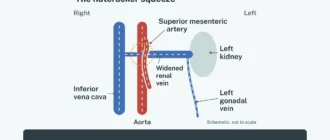
- Could I also have MALS, nutcracker syndrome or a motility problem that would affect the result?
- What happens if symptoms continue after the operation?
Read our guide to SMA syndrome, and about MALS and nutcracker syndrome, which can occur together with it.
MALS Compass is an independent educational website, not a medical provider, and is not affiliated with any hospital, clinic or university. This page is educational information and does not replace advice from your own doctor. For any question about your health, please contact your doctor or an official healthcare institution.