MALS and compression syndrome research: October 2026
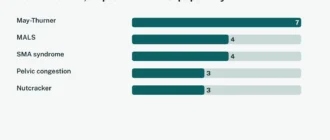
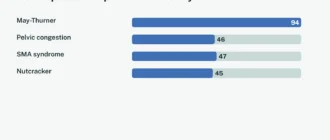
Every month we read every new paper on MALS, May-Thurner, nutcracker, pelvic congestion and SMA syndrome that was added to PubMed, the US National Library of Medicine database, and explain it in plain language. In October 2026, 40 papers were added; 31 of them are about these conditions and are summarized below, 12 of them case reports about one or two patients.
The month in brief
- Pelvic vein stents stayed open in most patients for several years
- Adding ovarian vein treatment to stenting eased more pelvic pain
- Most of 100 MALS patients had less pain after robotic surgery
- About one in six CT scans showed a squeezed left pelvic vein
- Most women with pelvic vein pain improved after stenting, despite delays
MALS (median arcuate ligament syndrome)
Most of 100 MALS patients had less pain after robotic surgery
One surgeon reviewed 100 patients who had robotic surgery to release the median arcuate ligament. Average age was 29, and the typical hospital stay was under three days. About 95% reported relief of chronic belly pain, and complications were uncommon. Patients with pain after all foods, weight loss, and relief from a nerve block before surgery did especially well.
Why it matters: These results suggest that careful patient selection may matter a lot, though they come from one surgeon and need confirmation elsewhere. Abstract on PubMed
Most MALS patients reported early pain relief after open surgery
Doctors at one hospital surveyed 224 patients after open surgery to cut the median arcuate ligament and nearby nerves. About 94% said their pain improved at first, but almost one in four of those had pain return, often within six months. People who got full relief from a nerve block before surgery had less pain return.
Why it matters: A nerve block test before surgery might help doctors and patients set expectations, but less than half of patients answered, so results need confirmation. Abstract on PubMed
Children improved after open surgery for MALS or nutcracker syndrome
Doctors at one academic center reviewed records of 17 children who had open surgery for MALS, nutcracker syndrome, or both. All had belly pain, and more than half had pain or nausea after eating. Many also had POTS (a condition where the heart races on standing) or hypermobile Ehlers-Danlos syndrome. All reported feeling better after surgery, but some had pain come back later.
Why it matters: This small, selected group suggests surgery can help some children, though pain may return, and the findings need confirmation in larger studies. Abstract on PubMed
Case reports (each describes one or two patients):
- This report describes one man who had six emergency operations over 11 years for stomach and bowel ulcers that kept coming back. A scan later showed the celiac artery (a main gut artery) was squeezed, which fits MALS. After surgery to release the ligament, he had no pain or new ulcers for 18 months. Abstract on PubMed
- This report describes one 77-year-old man with MALS, a bulge in the celiac artery, and hardened arteries elsewhere. He had pain after eating and poor nutrition. During keyhole surgery to release the ligament, the artery tore and bled heavily, and he later died from loss of blood flow to his bowel. Abstract on PubMed
Background: our guide to MALS.
May-Thurner syndrome
Pelvic vein stents stayed open in most patients for several years
Researchers pooled 13 studies with 1450 patients who got stents for long-term blockage of the iliac veins (main pelvic veins). After one year, 93% of stents were still open, and about 89% at three years. Stents did better in veins narrowed by pressure from outside (98% open) than in veins scarred by past clots (84%).
Why it matters: This larger summary suggests stents often stay open and ease symptoms, but the quality of the evidence was rated low, so results should be read with caution. Abstract on PubMed
About one in six CT scans showed a squeezed left pelvic vein
Researchers reviewed belly and pelvis CT scans from 726 patients scanned for other reasons. About 16% had the left iliac vein squeezed by more than half, more often in women (20%) than men (12%). These patients were thinner on average and more often had a past clot in the left leg.
Why it matters: This suggests that a squeezed pelvic vein found by chance on a scan may matter more than once thought, though more research is needed. Abstract on PubMed
Squeezed left pelvic vein was common and mostly harmless in healthy people
Researchers looked at CT scans of 102 healthy people being checked as kidney donors and followed them for about 11 years. Over a third had the left iliac vein narrowed by half or more, more often in young women. Over the follow-up, none of them developed serious left leg vein problems.
Why it matters: This suggests that a squeezed pelvic vein seen on a scan in someone without symptoms may not need treatment, which may help avoid unneeded procedures. Abstract on PubMed
Surgery reduced leg swelling from lymphedema in May-Thurner patients
Doctors at one academic center reviewed 26 people with May-Thurner syndrome and lymphedema (long-lasting swelling from poor lymph fluid drainage). All had already had iliac vein stents. People with more advanced swelling who had lymph surgery, often combined with other treatment, generally had their leg size go down, while therapy alone was less helpful in some groups.
Why it matters: It suggests people with May-Thurner syndrome may also develop lymphedema that can be treated, but the findings come from a small group at one center. Abstract on PubMed
Slower pelvic vein blood flow was linked to past leg clots
Doctors at one center compared ultrasound results in 45 people with a narrowed left iliac vein (main pelvic vein), nine of whom had a past leg clot. Slower blood flow at the narrow spot was more strongly tied to past clots than how narrow the vein looked. The difference in narrowing was smaller.
Why it matters: Measuring blood flow might one day help judge clot risk in people with narrowed pelvic veins, but this small study needs confirmation. Abstract on PubMed
Body position changed pelvic vein blood flow readings in healthy adults
Researchers used ultrasound to measure the large leg and pelvic veins in eight healthy volunteers while lying down and while standing. Blood flowed more slowly in the iliac veins (the main pelvic veins) when people stood up. The width of the veins did not change in a meaningful way between the two positions.
Why it matters: Because ultrasound is used to look for narrowed pelvic veins, knowing how position affects readings may help future testing, but this very small study needs follow-up. Abstract on PubMed
Ultrasound inside the vein showed intestine pressing on a pelvic vein
No abstract was available for this article. Based on its title, it describes how intravascular ultrasound (a tiny ultrasound probe placed inside the vein) showed the common iliac vein being pressed by nearby intestine, with the pressure changing over time.
Why it matters: It points to a less common cause of pelvic vein compression, but details are not available to judge how many patients it affects. Abstract on PubMed
Case reports (each describes one or two patients):
- This report describes one man with May-Thurner syndrome who had a stent (a small mesh tube that holds a vein open) in his pelvic vein. Two years later, scans showed the stent had broken and pieces had moved to his heart and lungs. One piece was caught in a heart valve, and he needed surgery to replace that valve. Abstract on PubMed
- This report describes one man who developed a large leg vein clot and lung clots one week after a penile implant was placed. Scans showed the implant's fluid reservoir was pressing on a pelvic vein. Doctors removed the clots with a catheter (a thin tube put into the vein) and placed two stents, and his leg flow returned. Abstract on PubMed
- This report describes one man with a severe, painful leg clot caused by May-Thurner syndrome (a pelvic vein squeezed by an artery). Ultrasound quickly showed the clot in his leg veins but could not see the squeezed pelvic vein. Other scans confirmed the cause, and treatment to remove the clot plus a stent relieved his swelling and pain. Abstract on PubMed
- This report describes one woman whose planned heart valve procedure through a leg vein could not go forward because the vein was tightly narrowed. Doctors widened it and placed a stent. A later scan also showed May-Thurner anatomy (a left pelvic vein pressed by an artery) that caused no symptoms, and the heart procedure was completed later. Abstract on PubMed
- This report describes one 63-year-old woman with leg pain and venous ulcers (open sores from poor vein flow). A Doppler ultrasound did not find a problem, and she later died after a fall. An autopsy found a clot in her left iliac vein that had been there for several days and had moved into a large vein. Abstract on PubMed
Background: our guide to May-Thurner syndrome.
Nutcracker syndrome
Robotic vein surgery for nutcracker syndrome had shorter hospital stays
Doctors at one center compared 88 patients treated with different versions of left renal vein transposition (moving the squeezed kidney vein to a new spot). Robotic versions took about 200 minutes versus 344 for standard surgery, with less blood loss and hospital stays of 4.5 versus 8 days. After surgery, pressure in the kidney vein was back in a normal range for everyone.
Why it matters: Patients with nutcracker syndrome may have more surgical choices in the future, but these single-center results need to be checked at other hospitals. Abstract on PubMed
Keyhole surgery helped most of nine patients with nutcracker syndrome
Doctors at one center reviewed nine patients who had laparoscopic (keyhole) surgery to move the squeezed left kidney vein. All surgeries were finished without opening the belly, and the typical hospital stay was four days. Most patients had full or major symptom relief. One had serious bleeding, and one later needed another operation when the vein closed off.
Why it matters: Keyhole surgery may be an option for some people with nutcracker syndrome, but this was a small group and longer follow-up is needed. Abstract on PubMed
Lying on the side eased kidney vein squeezing in children
Researchers reviewed ultrasound scans of 67 children with suspected nutcracker syndrome, taken in different body positions. Lying on either side made the squeezed left kidney vein look less narrowed than lying on the back. The share of children with an abnormal result dropped from about 63% on their back to about 24% to 31% on their side.
Why it matters: Testing in several positions may give a fuller picture, and the findings may support position changes during watchful waiting, but more study is needed. Abstract on PubMed
New CT measurements may help diagnose nutcracker syndrome in children
Researchers compared CT scans of 23 children with nutcracker syndrome and 45 children scanned for other reasons. They tested eight body measurements around the left kidney vein. A few of the new measurements, including one ratio, differed between the two groups and looked promising for diagnosis.
Why it matters: These measurements might one day be used with ultrasound to avoid CT scans in children, but they need testing in larger groups. Abstract on PubMed
Case reports (each describes one or two patients):
- This report describes one 14-year-old girl with 20 days of heavy uterine bleeding that needed a blood transfusion. Scans showed swollen ovarian veins and an unusual kidney vein position behind the aorta (the body's main artery), called posterior nutcracker syndrome. Surgery to move the kidney vein led to a good result in the medium term. Abstract on PubMed
- This report describes two siblings with an unusual kidney vein that wraps around the aorta, causing a rare type of nutcracker syndrome. Their pain came back after a first surgery to move the kidney vein. Both then had renal autotransplantation (moving their own kidney to a new place in the body), and their symptoms went away with kidney function kept. Abstract on PubMed
- This report describes one 18-year-old woman with belly and lower back pain and weight loss. Scans showed nutcracker syndrome, MALS, and May-Thurner syndrome together. In one open operation, doctors released the celiac artery, moved the kidney vein, and freed the pelvic vein. She recovered well, with good long-term symptom relief. Abstract on PubMed
Background: our guide to Nutcracker syndrome.
Pelvic congestion syndrome
Adding ovarian vein treatment to stenting eased more pelvic pain
Doctors at one hospital studied 184 women with May-Thurner syndrome and pelvic vein problems. Some got only an iliac vein stent, and others also had ovarian vein embolization (closing off leaky ovarian veins). At 12 months, pain was cut in half for 55% with a stent alone versus about 70% to 74% with the added treatment.
Why it matters: For women with leaky ovarian veins, the added step may help, but this was not a randomized study and the results need confirmation. Abstract on PubMed
Most women with pelvic vein pain improved after stenting, despite delays
Researchers studied 113 women with chronic pelvic pain from blocked iliac veins who were treated with stents. They had lived with pain for about six years on average. About seven years after stenting, around 80% had no pelvic pain. Women who saw two or more other specialists first waited longest for diagnosis and were less likely to have pain fully go away.
Why it matters: It suggests that pelvic pain from blocked veins can follow a clear pattern, and earlier recognition might shorten long delays for some women. Abstract on PubMed
Experts urge checking pelvic veins during routine pelvic ultrasound
This article argues that pelvic venous disorder (enlarged, leaky veins in the pelvis) is often missed as a cause of chronic pelvic pain. It suggests adding a short vein check to routine pelvic ultrasound. It notes that vein size alone is not reliable and that a Doppler test (ultrasound that shows blood flow direction) is needed to confirm backward flow.
Why it matters: If adopted, this approach could help some women with pelvic pain get a diagnosis sooner, though it is an opinion piece, not a study. Abstract on PubMed
AI chatbot answers about pelvic congestion were hard to read
Researchers asked three AI chatbots 18 common questions about pelvic congestion syndrome (pain from swollen pelvic veins). They scored the answers for how easy they were to read, their quality, and their reliability. All chatbots wrote above the recommended reading level, and overall quality scores were below ideal, with each chatbot doing better on different measures.
Why it matters: It suggests that patients reading chatbot answers about this condition may find them hard to follow and should treat them with care. Abstract on PubMed
A quick MRI scan without dye can show squeezed pelvic veins
Doctors describe a short MRI method that needs no contrast dye and takes about 10 minutes. It can show where the iliac (pelvic) veins or the left kidney vein are squeezed and reveal detour veins around the blockage. The authors note that these pictures alone do not prove a symptom-causing syndrome.
Why it matters: This may offer a simpler first scan for some patients, though other tests may still be needed before treatment. Abstract on PubMed
Background: our guide to Pelvic congestion syndrome.
SMA syndrome
Case reports (each describes one or two patients):
- This report describes one 13-year-old boy with vomiting after meals and weight loss. A scan showed SMA syndrome (the small bowel squeezed between two arteries), and also a squeezed left kidney vein that caused him no symptoms. Surgery to bypass the blocked bowel worked, and he was well four months later. Abstract on PubMed
- This report describes one 21-year-old woman who lost 36% of her weight in five months and then had severe vomiting. Scans confirmed SMA syndrome. When a first surgery to free the bowel did not work because of scar tissue, doctors switched to a bypass during the same operation. Two months later she had no symptoms and had gained 8 kg. Abstract on PubMed
Background: our guide to SMA syndrome.
How we write this digest
- We search PubMed for every paper added during the month, with the same searches we use for our outcome databases.
- Each summary is written by our editorial team from the paper's abstract only, in our own words. Full papers may contain more detail.
- We say how many patients a study included. Case reports and small studies cannot show how often something happens.
- New papers are not medical advice. Talk with your doctor before changing any treatment.
See also: live list of the newest papers, clinical trials tracker, September 2026 digest.
MALS Compass is an independent educational website, not a medical provider, and is not affiliated with any hospital, clinic or university. This page is educational information and does not replace advice from your own doctor. For any question about your health, please contact your doctor or an official healthcare institution.