Ovarian vein embolization and pelvic vein embolization: what to expect
Ovarian vein embolization is a minimally invasive procedure that closes widened, backward-flowing veins in the pelvis from the inside. It is the main treatment for pelvic congestion syndrome, a cause of long-lasting pelvic pain in women. When veins other than the ovarian veins are treated too, doctors often call it pelvic vein embolization. Researchers now describe it as the standard first treatment for women with chronic pain from faulty pelvic veins [1].
Key points
- The procedure is done through a thin tube placed in a vein in the neck, arm or groin, and it can be done as an outpatient [2].
- Doctors close the faulty veins with metal coils, plugs, glue or sclerosants (vein-irritating liquids or foams) [1][3].
- In our summary of every published study, 85% of 3,875 patients improved (weighted by study size), and the average pain score fell from 7.5 to 1.4 out of 10.
- Some women have a short flare of pelvic pain afterward; in one study it cleared up within a month [4].
- Symptoms come back in some women, and a repeat procedure can help [5]. The overall quality of the evidence is still rated as low [3].
What the procedure does
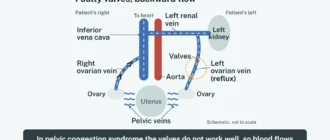
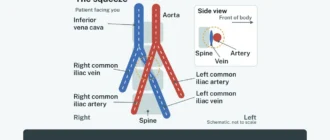
Pelvic congestion syndrome is linked to faulty ovarian or pelvic veins that let blood flow backward and pool, which leads to widened veins around the uterus and ovaries [6]. Embolization means blocking a blood vessel on purpose. Closing the faulty veins from inside, under live X-ray, aims to stop this backward flow.
Who it is for
Embolization is considered for women with typical pelvic pain whose imaging shows faulty pelvic veins. A French expert consensus recommends it only after a thorough imaging work-up [7]. One review notes that women who have had several pregnancies tend to do better than women whose main symptom is pain during sex [8]. You can read how the condition is found in our guide to pelvic congestion syndrome diagnosis.
If imaging also shows a narrowed iliac vein (the main vein draining the pelvis and leg), a stent may be used instead of, or together with, embolization [9]. In one series of 102 women, half had iliac vein compression, and embolization alone worked about as well in that group as in women without compression [10].
How it is done, step by step
- Numbing and sedation. The skin over the vein is numbed. Many teams also give light sedation (medicine to help you relax) [11]. In one clinic, the procedure was done under local numbing alone, outside a hospital, with no serious complications in 112 women [12].
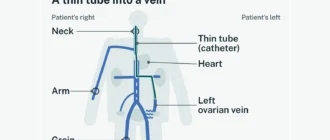
- Access. A needle and a thin tube (catheter) go into a vein in the groin, the neck or the arm [2]. Arm access was used in 201 women in one series, with technical success in 98.5% [2].
- Venography. Contrast dye is injected and X-ray pictures of the veins are taken. This venogram is the most accurate test for the condition and is usually done in the same session, right before the veins are closed [13].
- Closing the veins. The doctor places coils, plugs, glue or a sclerosant, alone or in combination [1]. In one series of 292 women, the left ovarian vein was treated in every woman, and the right ovarian vein and branches of the internal iliac veins were added when needed [14].
- Finish. The catheter is removed and pressure is put on the entry point.
In that series, done through an arm vein, the procedure took about 41 minutes on average [14].
Ovarian vein embolization, step by step (4 steps)

1. A thin tube into a vein. Often with only local numbing, the doctor puts a thin tube (catheter) into a vein in the groin, neck or arm. The tube is steered through the veins, past the heart, into the faulty ovarian vein. Source: study 1, study 2, study 3.

2. Dye X-ray finds faulty veins. Dye is injected through the tube while X-ray pictures are taken (venography). They show which veins let blood flow backward. In one large study this was the left ovarian vein in 78% of women. Source: study 1, study 2, study 3.


Prefer a video? Watch the 90-second captioned video explainer.
Recovery and return to activity
The procedure can be done on an outpatient basis, which means going home the same day [2][12]. In one study of 71 women treated with coils under local anesthesia and sedation, 80% reported a fast return to daily activity one week after the procedure [11].
Some women have post-embolization syndrome: more pelvic pain, tenderness along the treated vein and a mild fever. In a study of 70 women, this happened in 20% and cleared up completely by day 30 with anti-inflammatory and vein medicines [4].
The full benefit can take time. In one large center, women treated with ovarian vein embolization alone reached their lowest pain level at about 3 months, and the relief lasted up to 3 years [15]. An expert panel suggests judging success 3 to 6 months after the procedure [9].
Results
We collected every published study that reports an embolization success rate. The table below is from our summary of embolization outcomes.
| Measure | Result | Studies |
|---|---|---|
| Patients improved (weighted by study size) | 85% of 3,875 patients | 37 |
| Pain score before and after (0 to 10) | 7.5 before, 1.4 after | 15 |
| Technical success (median) | 100% | 21 |
| Recurrence (median) | 18.5% | 12 |
| Complications (median) | 4.2% | 16 |
One review of 1,308 women found early, substantial pain relief in about 75% [3]. A 2026 meta-analysis of 2,688 patients found technical success of 98.6% to 100%, but its authors asked readers to view the comparisons with caution because the studies were small [1].
Randomized trials are few and small. In one, 40 women were assigned to glue embolization or a vein medicine taken by mouth; after 12 months, pain scores were lower and symptoms came back less often with embolization (10% vs 45%) [16]. A review of coil-only studies describes two trials that reported better results with coils than with plugs or with hysterectomy [17].
Data on fertility are limited. In one small series of 12 women with infertility thought to be caused by pelvic congestion, 8 became pregnant after embolization [18].
Risks
- Coil or device migration. A coil can move away from where it was placed. One review put the risk of coil migration below 2% [3]. In the 2026 meta-analysis, complications, mainly device migration, were most common with coils, at about 2.6% [1]. In the series of 292 women, one coil traveled to the lungs and needed another procedure [14].
- Clots in small pelvic veins. In one single-center study of 150 women treated with coils, clots in the veins next to the uterus were found by ultrasound in 21.3%, and coils pushed through the vein wall in 5.3% [19].
- Bruising at the entry site (4% in that study) and allergic reactions (1.3%) were less common [19].
Across 25 studies, the overall complication rate was 9.0%, and most complications were minor [20].
Recurrence and repeat treatment
Pain can come back, and how often depends on how studies define recurrence. In coil-only studies, pain returned 1 to 2 years later in 5.9% to 25% of women [17]. When symptoms stayed or returned, a second procedure relieved pain at 3 months in 67.5% of 40 women, compared with 35.9% of 39 women who took vein medicines instead [5]. An expert panel says treatment failure should lead to a new evaluation and possible repeat treatment [9].
Some studies report much higher numbers. In a multicenter study of 244 women followed for 2 years, symptoms worsened again in 48%, most often in women who also had certain leg varicose veins linked to the pelvic veins [21].
Alternatives
- Medicines: hormonal medicines have been tested in a small randomized trial [22], and vein medicines are also used. In the randomized trial above, a vein medicine gave less durable relief than embolization [16].
- Iliac vein stenting: for a narrowed iliac vein, alone or combined with embolization [9].
- Surgery: removing the ovarian vein through keyhole surgery [11], or hysterectomy. In an older study of 106 women, embolization reduced pain more than hysterectomy with removal of the ovaries [23]. Reviews say medical and surgical options have largely been replaced by embolization in specialist practice [13].
Questions to ask your doctor
- Which veins do you plan to treat, and which material will you use?
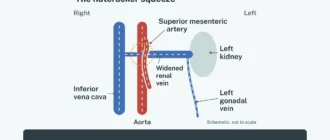
- Will you check the iliac veins and the left kidney vein before deciding?
- Which entry point will you use, and will I have sedation?
- What should I expect in the first month, and when should I call you?
- What is your plan if my pain comes back?
Learn more: our guide to pelvic congestion syndrome, how pelvic congestion syndrome is diagnosed, and embolization outcomes from every published study.
Where is it treated? See US hospitals that publish on pelvic congestion syndrome, by state.
Sources
- Strobl F, Bohm AK, Mertens L, et al. Pelvic vein embolization using different embolic agents for the treatment of pelvic venous insufficiency: A systematic review and meta-analysis. J Vasc Surg Venous Lymphat Disord. 2026;14(6):102599. PubMed 42571790
- Zander T, Vicente S, Garcia G, et al. The Transbrachial Venous Approach for Pelvic Congestion Syndrome Embolization: An Easy Way to Outpatient Procedure. Ann Vasc Surg. 2022;78:373-376. PubMed 34500019
- Daniels JP, Champaneria R, Shah L, et al. Effectiveness of Embolization or Sclerotherapy of Pelvic Veins for Reducing Chronic Pelvic Pain: A Systematic Review. J Vasc Interv Radiol. 2016;27(10):1478-1486.e8. PubMed 27397619
- Gavrilov SG, Krasavin GV, Mishakina NY, et al. Postembolization syndrome in endovascular interventions on the gonadal veins. J Vasc Surg Venous Lymphat Disord. 2021;9(3):697-702. PubMed 32932000
- Xue S, Li F, Lu T, et al. Endovascular reintervention versus conservative medical therapy for persistent or recurrent venous-origin chronic pelvic pain after primary ovarian vein embolization. J Vasc Surg Venous Lymphat Disord. 2026;14(6):102571. PubMed 42379296
- Dewald CLA, Becker LS, Meyer BC. Interventional Therapy of Pelvic Venous Disorders (PeVD). Rofo. 2024;196(9):921-927. PubMed 38373714
- Pennec VL, Douane F, Brun JL, et al. Endovascular management of pelvic congestion syndrome: An expert consensus statement from the French Society of Cardiovascular Imaging (SFICV), Interventional Radiology Federation (FRI), College of French Radiology Teachers (CERF), and French Society of Women's Imaging (SIFEM). Diagn Interv Imaging. 2025;106(10):356-366. PubMed 40312243
- Joh M, Grewal S, Gupta R. Ovarian Vein Embolization: How and When Should It Be Done? Tech Vasc Interv Radiol. 2021;24(1):100732. PubMed 34147199
- Baccellieri D, Basile A, Arena A, et al. Delphi consensus on diagnostic and therapeutic pathways for pelvic venous disorders - A multidisciplinary algorithm. Vasa. 2026;55(6):379-388. PubMed 41782320
- Xue S, Lu T, Sun Q, et al. Impact of Iliac Vein Compression on the Outcome of Pelvic Venous Embolization in Patients with Pelvic Venous Disorder. J Vasc Interv Radiol. 2026;37(5):108545. PubMed 41580226
- Gavrilov SG, Grishenkova AS, Mishakina NY, et al. Use of a novel Likert scale instrument to assess patient satisfaction following endovascular and surgical treatment of pelvic venous disorders. Phlebology. 2022;37(4):241-251. PubMed 35258386
- Whiteley MS, Lewis-Shiell C, Bishop SI, et al. Pelvic vein embolisation of gonadal and internal iliac veins can be performed safely and with good technical results in an ambulatory vein clinic, under local anaesthetic alone - Results from two years' experience. Phlebology. 2018;33(8):575-579. PubMed 28992753
- Kashef E, Evans E, Patel N, et al. Pelvic venous congestion syndrome: female venous congestive syndromes and endovascular treatment options. CVIR Endovasc. 2023;6(1):25. PubMed 37076700
- Pinzon-Pinto M, Portilla-Rojas E, Gonzalez-Cordoba A, et al. Basilic vein access as an effective alternative for endovascular embolization of pelvic varicose veins: A retrospective-cohort based population study. Vascular. 2026;34(4):819-824. PubMed 41766632
- Ma N, Lakhanpal G, Kennedy R, et al. Long-term clinical effectiveness of endovenous interventions for pelvic venous disorders. J Vasc Surg Venous Lymphat Disord. 2026;14(6):102597. PubMed 42556527
- Eleissawy MI, Mokhtar HM, Ageez MN, et al. Transcatheter cyanoacrylate embolization vs. pharmacologic therapy for gonadal vein reflux in symptomatic pelvic venous disorders: a randomized controlled trial. Diagn Interv Radiol. 2026. PubMed 42084271
- Sutanto SA, Tan M, Onida S, et al. A systematic review on isolated coil embolization for pelvic venous reflux. J Vasc Surg Venous Lymphat Disord. 2022;10(1):224-232.e9. PubMed 34358670
- Liu J, Han L, Han X. The Effect of a Subsequent Pregnancy After Ovarian Vein Embolization in Patients with Infertility Caused by Pelvic Congestion Syndrome. Acad Radiol. 2019;26(10):1373-1377. PubMed 30660471
- Gavrilov SG, Mishakina NY, Efremova OI, et al. Complications and Adverse Events of Gonadal Vein Embolization with Coils. J Pers Med. 2022;12(11). PubMed 36422109
- Hanna J, Bruinsma J, Temperley HC, et al. Efficacy of embolotherapy for the treatment of pelvic congestion syndrome: A systematic review. Ir J Med Sci. 2024;193(3):1441-1451. PubMed 38294607
- Yamamoto-Ramos M, De Gregorio MA, de Blas I, et al. Understanding Recurrence in Pelvic Venous Disorders through the Symptoms-Varices-Pathophysiology Classification: A Multicenter Prospective Cohort Study. J Vasc Interv Radiol. 2026;37(7):108758. PubMed 41895652
- Soysal ME, Soysal S, Vicdan K, et al. A randomized controlled trial of goserelin and medroxyprogesterone acetate in the treatment of pelvic congestion. Hum Reprod. 2001;16(5):931-9. PubMed 11331640
- Chung MH, Huh CY. Comparison of treatments for pelvic congestion syndrome. Tohoku J Exp Med. 2003;201(3):131-8. PubMed 14649734
MALS Compass is an independent educational website, not a medical provider, and is not affiliated with any hospital, clinic or university. This page is educational information and does not replace advice from your own doctor. For any question about your health, please contact your doctor or an official healthcare institution.