Pelvic congestion syndrome in men: pelvic venous disorders and varicocele
Pelvic congestion syndrome is best known as a cause of long-lasting pelvic pain in women. It happens when veins in the pelvis widen and blood flows backward through leaky valves. Men have the same kind of veins, and doctors now describe pelvic congestion syndrome in men as well, although it is rarely reported and often missed [1][2].
This page explains the terms doctors use, the symptoms reported in studies, how the condition links with nutcracker syndrome and May-Thurner syndrome, and what treatments and results have been published. The research in men is small, so many numbers come from single studies.
Key points
- In men, the most common form of pelvic vein reflux is a varicocele, a group of widened veins around the testicle [1][3].
- Pelvic vein problems in men can also occur without a varicocele, and venography (a dye X-ray of the veins) may be needed to find them [2].
- Squeezing of the left kidney vein (nutcracker syndrome) or of the left iliac vein (May-Thurner syndrome) can push blood into pelvic veins [4][9].
- In one study of 445 men with chronic pelvic pain, 49 had pelvic varicose veins, and about half of those had a vein compression as the cause [9].
- Treatments include closing off veins from the inside (embolization), surgery for varicocele, and stenting of a compressed iliac vein [3][9].
Does pelvic congestion happen in men?
Yes, but the words used are different. In women, doctors speak of pelvic congestion syndrome. In men, the usual term is varicocele, and the broader term for both sexes is pelvic venous disorders or pelvic venous insufficiency. A review describes varicocele in men and pelvic congestion in women as closely related, because the main cause of both is pelvic vein reflux. Varicocele affects about 15% of men in the general population and is more common in men with fertility problems [1].
In men, this reflux usually starts from weak valves a person is born with, and it most often shows as a varicocele that can be seen or felt [3]. A 2026 report of 2 men with chronic pelvic pain showed that pelvic vein reflux can also involve veins around the bladder, prostate and pelvic floor without a varicocele, sometimes after earlier varicocele surgery [2].
Symptoms reported in men
- Varicocele and scrotal pain. A varicocele is a common cause of pain in the scrotum and is linked with lower fertility [15][1].
- Pelvic or perineal pain. Pelvic varicose veins have been found in men with chronic pelvic pain syndrome, a long-lasting pain in the pelvis and perineum (the area between the scrotum and the anus) [9].
- Other problems. In a study of 132 patients treated for pelvic venous disorder or May-Thurner syndrome, other conditions such as chronic prostatitis, sexual problems, hemorrhoids and leg varicose veins were reported in more than half of the cases [10]. One case report describes painful ejaculation as a symptom [11].
- Blood in the urine. This points toward nutcracker syndrome (see below) [5][6].
Links with nutcracker syndrome and May-Thurner syndrome
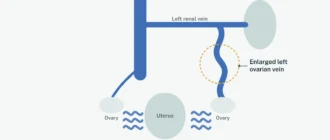
Nutcracker syndrome is squeezing of the left kidney (renal) vein, most often between the aorta and the superior mesenteric artery. The blocked blood finds another way out through the testicular and pelvic veins, which can cause a varicocele [4]. Learn more in our nutcracker syndrome guide.
- In a systematic review of 384 patients with nutcracker syndrome, blood in the urine was found in 69.5%, flank or belly pain in 48.4%, pelvic pain in 23.1% and varicocele in 15.8% [5].
- In a review of 736 patients with blood in the urine caused by a squeezed kidney vein, 29% of the male patients had a clinically relevant left varicocele [6].
- In 100 men with fertility problems and a varicocele, 6 had signs of kidney vein squeezing on ultrasound, and 5 of those 6 had blood or protein in the urine [7].
- Not every finding matters. In 137 teenagers with a varicocele, 56% showed kidney vein squeezing on ultrasound, but this was not linked with worse testicle findings or more surgery [8].
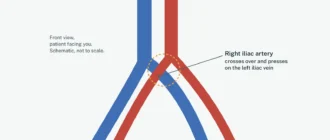
May-Thurner syndrome is squeezing of the left common iliac vein, the main vein from the left leg and pelvis. In a study of 445 men with chronic pelvic pain, 24 had pelvic varicose veins caused by a compression: 13 from May-Thurner syndrome and 11 from nutcracker syndrome [9]. See our May-Thurner syndrome page.
Tests
A physical exam and ultrasound are the main tests for a varicocele, and venography is considered the most exact test [1]. For suspected nutcracker syndrome, a review recommends duplex ultrasound for all patients, with CT or MRI as needed, and venography with pressure measurement before any procedure [5]. In the 2026 case report, ultrasound looked normal around the testicles, and only selective venography showed the abnormal pelvic veins [2]. The tests used in women are covered on our pelvic congestion diagnosis page.
Treatments and results
Treatment depends on the cause. The table lists published results. Most studies are small, and many did not compare treatments with each other.
| Treatment | Study | Result |
|---|---|---|
| Varicocele surgery for scrotal pain | 47 patients | Pain fully resolved in 64.3%, improved in 21.4%, persisted in 11.9%, worse in 2.4% [15] |
| Varicocele embolization | Review of 21 studies, 2,236 patients | All 4 studies that measured pain reported better pain scores [16] |
| Repeat treatment for a varicocele that came back | Review of 18 studies, 1,073 patients | Pain relief in more than 90%; overall evidence rated low [17] |
| Iliac vein stenting for pelvic vein disorders or May-Thurner (one study in men, no comparison group) | 132 patients | Clear improvement in 91% [10] |
| Testicular and pelvic vein embolization (nutcracker) or iliac stenting (May-Thurner) | 24 men | All stents stayed open, and all treated testicular veins stayed closed during follow-up [9] |
Embolization is a procedure through a small tube in a vein, in which the faulty vein is closed with coils, plugs or a foam medicine [2][16]. For varicocele it is now a first-line treatment [3]. Both men in the 2026 case report had complete and lasting relief after targeted embolization [2].
When nutcracker syndrome is behind a varicocele, the varicocele may come back after standard surgery. In a study of 3,042 men having varicocele surgery, 858 had a squeezed kidney vein. The recurrence rate was 1.98% in that group and 0.05% in the others [12]. Some surgeons therefore treat the kidney vein compression or create a new drainage path for the blood. In 4 teenage boys with a returning varicocele and nutcracker syndrome, open vein surgery relieved symptoms [13]. In a randomized trial of 50 men with nutcracker syndrome and a left varicocele, a bypass of the testicular vein into a vein of the belly wall gave better semen quality and kidney vein flow than standard varicocele surgery, but took longer and needed a longer hospital stay [14].
Because nutcracker syndrome involves several specialties, a review recommends a team approach with urology, radiology, kidney doctors and vascular surgery [4].
Questions to ask your doctor
- Could my pelvic, perineal or scrotal pain come from the veins, and not only from the prostate or muscles?
- Do I have a varicocele, and on which side?
- Should my left kidney vein and left iliac vein be checked for compression?
- Would venography change my treatment plan?
- If I have a varicocele and nutcracker syndrome, what is the chance it comes back after standard surgery?
- Which treatment do you suggest, embolization, surgery or stenting, and why?
Related pages: pelvic congestion syndrome, how pelvic congestion is diagnosed, nutcracker syndrome guide, May-Thurner syndrome.
Sources
- Galea M, Brincat MR, Calleja-Agius J. A review of the pathophysiology and evidence-based management of varicoceles and pelvic congestion syndrome. Hum Fertil (Camb). 2023;26(6):1597-1608. PubMed 37190955
- Castiglione DG, Grigoli PD, Amaduri A, et al. Endovascular management of pelvic congestion syndrome in males: A report of 2 cases. Radiol Case Rep. 2026;21(5):2049-2055. PubMed 41769185
- Paisant-Thouveny F, Le Pennec V, Loffroy R. [Varicoceles, pelvic varices and pelvic congestion syndrome: Interventional radiology in diagnosis and treatment]. Presse Med. 2019;48(4):419-434. PubMed 31097262
- Macioniene E, Kerpauskiene A, Zakauskiene U, et al. Nutcracker syndrome in 2026: a nephrologist-oriented diagnosis and management. Clin Kidney J. 2026;19(5):sfag124. PubMed 42111894
- Nastasi DR, Fraser AR, Williams AB, et al. A systematic review on nutcracker syndrome and proposed diagnostic algorithm. J Vasc Surg Venous Lymphat Disord. 2022;10(6):1410-1416. PubMed 36007798
- Vianello FA, Mazzoni MB, Peeters GG, et al. Micro- and macroscopic hematuria caused by renal vein entrapment: systematic review of the literature. Pediatr Nephrol. 2016;31(2):175-84. PubMed 25627663
- Abudu OA, Ogunjimi MA, Ojewola RW, et al. Sonographic Diagnosis of Anterior Nutcracker Phenomenon and its Prevalence in Nigerian Males with Varicoceles. J West Afr Coll Surg. 2025;15(3):344-349. PubMed 40586074
- Hannick JH, Blais AS, Kim JK, et al. Prevalence, Doppler Ultrasound Findings, and Clinical Implications of the Nutcracker Phenomenon in Pediatric Varicoceles. Urology. 2019;128:78-83. PubMed 30885542
- Berlizeva OU, Aboyan IA, Amosov AV, et al. [Endovascular treatment of secondary varicose veins of the pelvis in men with chronic pelvic pain syndrome]. Urologiia. 2021(2):46-50. PubMed 33960156
- Shakhmalova I, Myasoutova L, Morozova V, et al. Endovascular Approaches to Diagnosing Pelvic Varicose Veins in Men: Investigating Efficacy and Outcomes. Surg Technol Int. 2025;45. PubMed 39869846
- Cifuentes S, Ulloa JH, Van Uden E, et al. Painful ejaculation in a patient with pelvic venous insufficiency. J Vasc Surg Cases Innov Tech. 2022;8(4):602-605. PubMed 36248386
- Li S, Liu Q, Wang J, et al. Association Between Left Renal Vein Entrapment and Varicocele Recurrence: A Cohort Study in 3042 Patients. Sci Rep. 2018;8(1):10534. PubMed 30002433
- Mosavari H, Sarafi M, Hosseininasab A, et al. Renal nutcracker syndrome presenting with varicocele: A case series. Int J Surg Case Rep. 2024;124:110393. PubMed 39353314
- Dou K, Zeng X, Yang Q, et al. Microscopic ligation combined with shunt procedure versus microsurgical varicocelectomy for nutcracker syndrome and left varicocele: a randomized controlled trial. Basic Clin Androl. 2026;36(1). PubMed 41998517
- Alkhayal A, Aljumaiah S, Alhagbani A, et al. Varicocelectomy for scrotal pain: Is it effective? Urol Ann. 2023;15(3):311-314. PubMed 37664099
- Kasunic D, Crebert M, Treacy PJ, et al. Comparing the efficacy of different embolisation materials in improving pain and fertility outcomes in patients with varicoceles: A systematic review. J Med Imaging Radiat Oncol. 2025;69(1):112-125. PubMed 39462435
- Fallara G, Tang S, Pang KH, et al. Treatment of Persistent or Recurrent Varicoceles: A Systematic Review. Eur Urol Focus. 2023;9(3):531-540. PubMed 36443199
MALS Compass is an independent educational website, not a medical provider, and is not affiliated with any hospital, clinic or university. This page is educational information and does not replace advice from your own doctor. For any question about your health, please contact your doctor or an official healthcare institution.