Left renal vein transposition and other nutcracker syndrome surgery
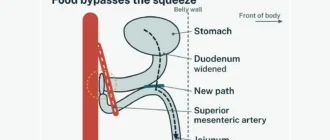
Nutcracker syndrome happens when the left renal vein, the vein that drains blood from the left kidney, is squeezed between the aorta and the superior mesenteric artery (SMA), like a nut in a nutcracker [4]. The blocked vein can cause left flank pain, blood in the urine, pelvic pain and, in men, swollen veins in the scrotum (varicocele) [3].
Left renal vein transposition is the operation experts most often name as the first surgical choice [1]. This page explains what nutcracker syndrome surgery tries to do, how the transposition is done, the other options, recovery, results and risks. For the condition itself, see our nutcracker syndrome guide.
Key points
- Many people with mild symptoms do well without surgery; in a large US multicenter study, treatment without surgery worked for 78% of those who tried it [3].
- In an international expert consensus, left renal vein transposition was agreed to be the first choice of operation [1].
- The operation can be done open, by keyhole (laparoscopic) surgery or with a surgical robot [2].
- In our summary of published studies, 91% of 615 patients improved after a procedure, but most studies were small, and repeat procedures were common.
- Stents placed inside the vein can move out of place, which is why experts are cautious about them [1][8].
What nutcracker syndrome surgery aims to do
Every procedure for nutcracker syndrome has the same goal: to take the pressure off the left renal vein so blood can drain from the kidney normally again [4]. Surgeons can do this by moving the vein, by holding it open from the outside or inside, by giving the blood another way out, or by moving the kidney itself [2].
A CT scan can show a squeezed vein in people who have no symptoms at all, so imaging alone does not decide treatment [1]. Experts agree that imaging is needed to confirm the diagnosis, but they could not agree on exact cut-off values [1]. Surgery is usually considered only for persistent, severe symptoms [6][13]. In children, doctors usually start with watchful waiting, because many outgrow the condition [4].
Left renal vein transposition: how it works
In a transposition, the surgeon detaches the left renal vein from the inferior vena cava (the large vein that carries blood back to the heart) and sews it back on lower down, below the spot where the SMA crosses [5][14]. The vein then no longer passes through the narrow gap between the two arteries.
In simple terms:
- You are fully asleep under general anesthesia.
- The surgeon reaches the vein through the abdomen [13].
- The vein is cut free and reattached to the vena cava at a lower point. Some surgeons add a small patch or cuff of the patient's own vein to widen the new connection [5].
- If the vein is too short or scarred, it may need to be rebuilt or lengthened; in one series of 43 transpositions this was needed in 35% [12].
Left renal vein transposition, step by step (4 steps)

1. Reaching the vein. The surgeon reaches the left renal vein and the inferior vena cava through the abdomen. The operation can be open, laparoscopic or robotic. Source: study 1, study 2, study 3, study 4, study 5.

2. Clamping and dividing. Clamps hold back blood in the vein and in part of the vena cava. The left renal vein is then cut where it joins the vena cava. Source: study 1, study 2.


Prefer a video? Watch the 90-second captioned video explainer.
Open, laparoscopic or robotic
- Open: the traditional approach through a larger cut. In one series of 37 patients treated mostly with open transposition, there were no major early complications and symptoms resolved in 87% [5].
- Laparoscopic: done through several small cuts with a camera. In a series of 9 patients, all operations were finished without switching to open surgery and the median hospital stay was 4 days [6].
- Robotic: a form of keyhole surgery in which the surgeon controls the instruments through a robot. In one center's series of 88 patients, one robotic technique had a shorter hospital stay than conventional surgery (4.5 vs 8 days) [7].
Keyhole and robotic results come mainly from single centers, and larger studies are still needed [6].
Other options, briefly
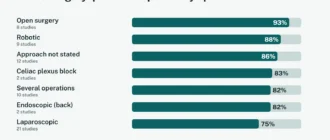
- External stent: a ring-shaped support is placed around the outside of the vein, usually by keyhole or robotic surgery, to keep it from being squeezed. In a systematic review, symptoms resolved in 83% after this approach [9].
- Endovascular stent: a metal mesh tube is placed inside the vein through a needle puncture, without a surgical cut. In the same review, symptoms resolved in 76% [9]. The main concern is that the stent can move: in one center's series of 75 patients, stents moved in 5 (6.7%), in some cases as far as the heart [8]. In a large US multicenter study, stenting inside the vein had worse results than surgery and was judged not suitable as a first treatment [3].
- Gonadal vein procedures: the ovarian or testicular vein is reconnected to give kidney blood another way out. In a series of 11 patients, pain scores dropped and blood in the urine cleared in everyone who had it [11].
- Kidney autotransplantation: the kidney is moved lower in the body, to the pelvis, so its vein no longer passes between the arteries. In a multicenter study of 105 patients, 93% had lasting relief of flank pain at 12 months [10]. A review describes it as usually kept for hard-to-treat cases [4].
Recovery
Reported hospital stays after transposition range from about 4 days with keyhole or robotic surgery to about 8 days with conventional surgery [6][7]. After gonadal vein surgery, the median stay in one series was 4 days [11]. Follow-up scans are important, because the new connection can narrow or close over time [5][6]. Ask your team how often you will need ultrasound or other scans and what signs should make you call.
Results
Our team collected every published study we could find on nutcracker syndrome treatment. See our summary of every published study for details. Most of these studies are small and come from single centers, so treat the numbers with care.
| Treatment | Studies with a rate | Patients | Improved (weighted) |
|---|---|---|---|
| All procedures | 26 | 615 | 91% |
| Renal vein transposition, open | 2 | 11 | 91% |
| External stent | 6 | 148 | 94% |
| Endovascular stent | 4 | 82 | 97% |
| Observation only | 2 | 143 | 47% |
In the same dataset, the median rate of repeat procedures was 17.5% (10 studies), and the median stent migration rate after endovascular stents was 6.8% (6 studies). The high success rate for stents inside the vein comes from a few small series and does not match the large US multicenter study, which found worse results with them [3].
A systematic review of 24 studies and 578 patients found symptom resolution in 92% after left renal vein transposition, but also the highest repeat-procedure rate, 28.5% [2]. In the large US multicenter study of 250 patients, about 40% of those treated with surgery had symptoms return within 3 years [3].
Risks
- Narrowing or blockage of the vein at the new connection, which may need a stent or another operation. In one open-surgery series, about 1 in 3 patients needed a second procedure [5].
- Bleeding: in the laparoscopic series of 9 patients, 1 had major bleeding that needed a transfusion [6].
- Problems with tissue used to lengthen the vein: one series reported 7 vein complications after transposition, most of them when a cow-tissue (bovine pericardium) graft was used [12].
- Varicocele may remain: in one series, varicoceles came back in 2 of 3 men even though flank pain improved [13].
- Stent movement after endovascular stents, as described above; reviews also mention narrowing inside the stent and open questions about how long stents last [8][15].
See US hospitals that publish on nutcracker syndrome.
Questions to ask your doctor
- Do my tests show that the squeezed vein is really causing my symptoms?
- Could I try treatment without surgery first, and for how long?
- Why do you suggest transposition, a stent or another option for me?
- Will the operation be open, laparoscopic or robotic, and how many have you done?
- How will we check that the vein stays open after surgery?
- What happens if my symptoms come back?
Related pages: nutcracker syndrome guide, nutcracker syndrome treatment results, nutcracker syndrome treatment centers.
Sources
- Heilijgers F, Gloviczki P, O'Sullivan G, et al. Nutcracker syndrome (a Delphi consensus). J Vasc Surg Venous Lymphat Disord. 2025;13(1):101970. PubMed 39362632
- Sarikaya S, Altas O, Ozgur MM, et al. Contemporary Management of Nutcracker Syndrome: A Systematic Review. Ann Vasc Surg. 2025;121:406-421. PubMed 40816484
- Suckow BD, Ponukumati A, Wang L, et al. Open surgery appears to be the preferred treatment in patients with nutcracker syndrome: A vascular low frequency disease consortium analysis. J Vasc Surg Venous Lymphat Disord. 2026;14(4):102497. PubMed 41985840
- Kolber MK, Cui Z, Chen CK, et al. Nutcracker syndrome: diagnosis and therapy. Cardiovasc Diagn Ther. 2021;11(5):1140-1149. PubMed 34815965
- Erben Y, Gloviczki P, Kalra M, et al. Treatment of nutcracker syndrome with open and endovascular interventions. J Vasc Surg Venous Lymphat Disord. 2015;3(4):389-396. PubMed 26992616
- Mizera P, Cywinski J, Pajak M, et al. Laparoscopic Left Renal Vein Transposition for Nutcracker Syndrome: A Single-Center Case Series. Ann Vasc Surg. 2026. PubMed 42869179
- Xu J, Xu Z, Huang Z, et al. Robotic left renal vein transposition for nutcracker syndrome: side-clamp to tailored reconstruction. BJU Int. 2026. PubMed 42847027
- Wu Z, Zheng X, He Y, et al. Stent migration after endovascular stenting in patients with nutcracker syndrome. J Vasc Surg Venous Lymphat Disord. 2016;4(2):193-9. PubMed 26993867
- Fuentes-Perez A, Bush RL, Kalra M, et al. Systematic review of endovascular versus laparoscopic extravascular stenting for treatment of nutcracker syndrome. J Vasc Surg Venous Lymphat Disord. 2023;11(2):433-441. PubMed 36404475
- Philip JL, Saben J, Meram E, et al. Renal autotransplant as a definitive treatment for nutcracker syndrome: A multicenter retrospective study. J Vasc Surg Venous Lymphat Disord. 2025;13(1):101983. PubMed 39326788
- Debucquois A, Salomon du Mont L, Bertho W, et al. Current results of left gonadal vein transposition to treat nutcracker syndrome. J Vasc Surg Venous Lymphat Disord. 2021;9(6):1504-1509. PubMed 33737260
- Schweitzer G, Jreij G, Dunlap E, et al. Surgical Options and Outcomes for Renal Vein Entrapment. Vasc Endovascular Surg. 2025;59(7):681-689. PubMed 40320391
- Reed NR, Kalra M, Bower TC, et al. Left renal vein transposition for nutcracker syndrome. J Vasc Surg. 2009;49(2):386-93; discussion 393-4. PubMed 19216958
- Menard MT. Nutcracker syndrome: when should it be treated and how? Perspect Vasc Surg Endovasc Ther. 2009;21(2):117-24. PubMed 19703821
- Peric V, Ferenc T, Bratic T, et al. Controversies in treating nutcracker syndrome. CVIR Endovasc. 2025;8(1):26. PubMed 40148589
MALS Compass is an independent educational website, not a medical provider, and is not affiliated with any hospital, clinic or university. This page is educational information and does not replace advice from your own doctor. For any question about your health, please contact your doctor or an official healthcare institution.